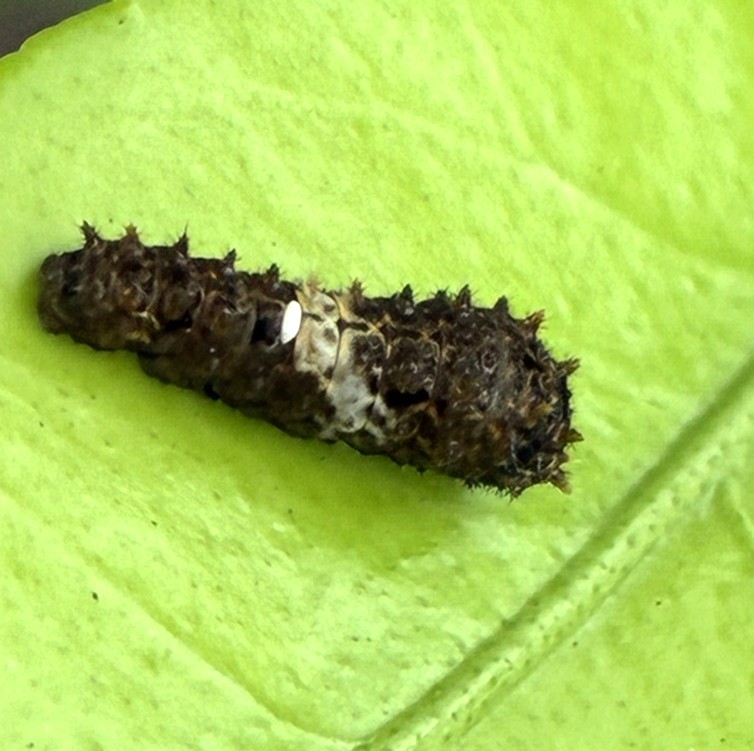
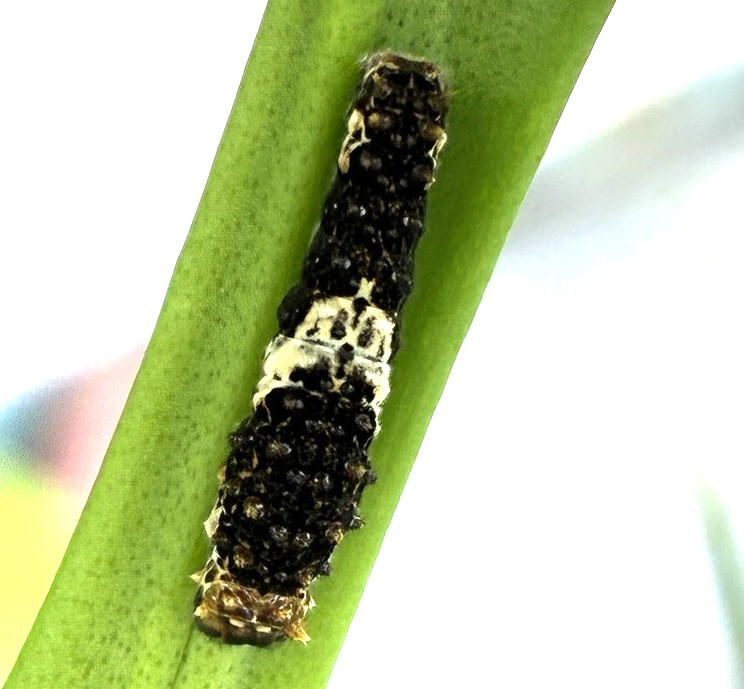
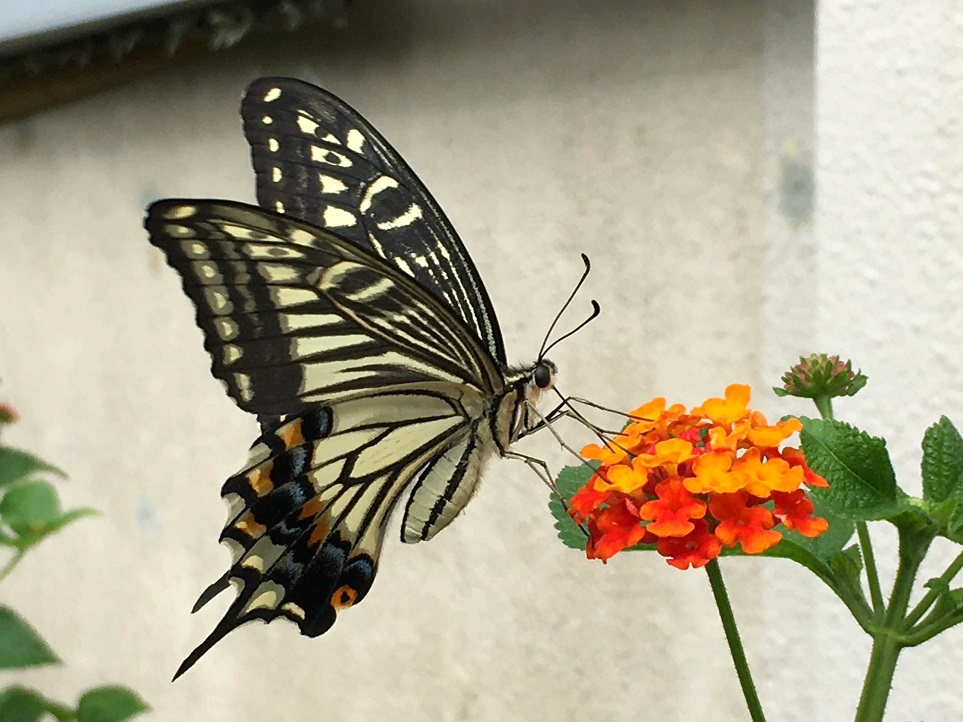
The first two images show larvae of the Asian swallowtail butterfly (Papilio xuthus), both in their 1st–2nd instar “bird-dropping” form, before they turn green. Their transformation into the beautiful adult butterfly feels almost miraculous—this is what we call complete metamorphosis in butterflies.
Spiders are often seen as villains, yet they are fascinating and mysterious creatures. The key points that distinguish “insects” from other “bugs” are whether the body is divided into head, thorax, and abdomen, and whether they have three pairs of legs. Spiders meet neither condition and are therefore not insects. Their close relatives include mites and scorpions. Although spiders are disliked, almost none in Japan pose any harm to humans. Even without being Fabre, one can find spiders deeply intriguing.
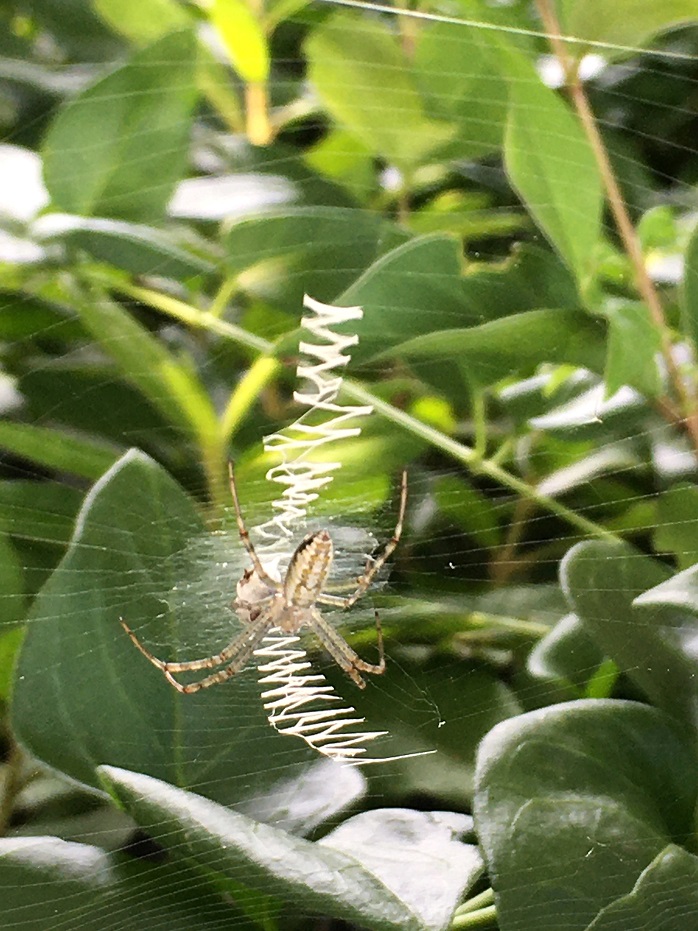
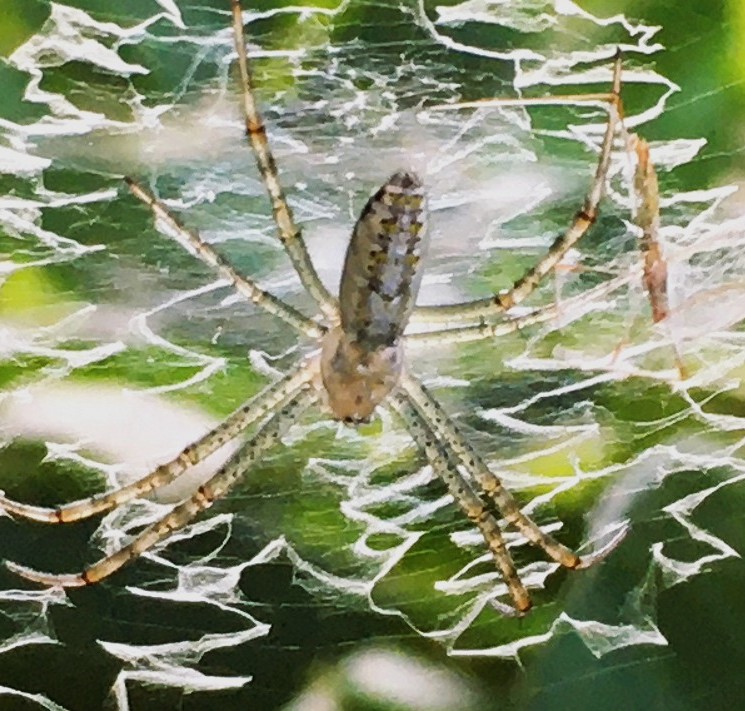
In the image, you can see a white zigzag pattern on the web—this is the stabilimentum. It stands out starkly, even from afar, with the rest of the web surrounding it. Juvenile Argiope amoena (the long-bodied orb-weaver) often build webs with this stabilimentum. There are several hypotheses: the concealment theory (hiding the spider from predators), the advertisement theory (making birds notice the web so they avoid breaking it), the intimidation theory (making the spider appear larger), the adjustment theory (final tuning of the web), and the reinforcement theory (strengthening the web).
Spiders grow by molting repeatedly throughout their lives. Males molt about six times, females seven to eight times (females are larger and molt more). After their final molt in mid-summer, they become mature adults capable of mating. Compared with the butterfly’s complete metamorphosis, this can be considered a form of incomplete metamorphosis.
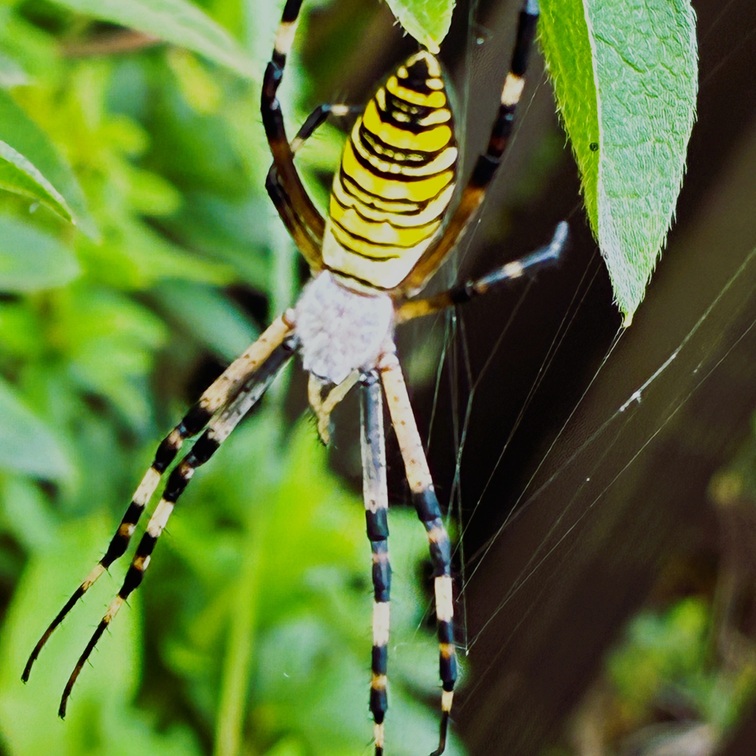
Unlike butterflies, it is difficult to determine the exact number of molts in spiders just by appearance. As Argiope amoena grows, its stabilimentum gradually becomes a long, straight vertical zigzag. Juveniles have pale bodies—white or light lime green—but adults develop a striking yellow-and-black warning coloration.
Compared with Argiope amoena, what characterizes human development? Humans exhibit pronounced neoteny—retaining juvenile traits into adulthood. Our developmental period is extremely long, and newborns are physiologically premature. Even after weaning, children cannot feed themselves independently. Humans also have an old age stage, which carries social roles. Unlike butterflies or spiders, humans do not undergo metamorphosis or molting; instead, we mature while retaining juvenile features.
By comparing the butterfly’s complete metamorphosis, the spider’s molting, and the human experience of neoteny, we gain a glimpse into what “growth” means within the broader process of living.
Mariposas, Arañas y Seres Humanos
Las dos primeras imágenes muestran larvas de la mariposa Papilio xuthus, ambas en su forma de “excremento de ave” de los estadios 1–2, antes de volverse verdes. Su transformación en la hermosa mariposa adulta parece casi un milagro natural; esto es lo que llamamos metamorfosis completa en las mariposas.
Las arañas suelen considerarse criaturas siniestras, pero en realidad son seres fascinantes y enigmáticos. Para distinguir a los “insectos” de otros “bichos”, se observan dos puntos: si el cuerpo está dividido en cabeza, tórax y abdomen, y si poseen tres pares de patas. Las arañas no cumplen ninguna de estas condiciones y, por lo tanto, no son insectos. Sus parientes cercanos incluyen los ácaros y los escorpiones. Aunque muchas personas las rechazan, casi ninguna especie en Japón representa un peligro para los humanos. Incluso sin ser Fabre, uno puede encontrar a las arañas profundamente interesantes.
En la imagen se aprecia un patrón blanco en zigzag en la telaraña: el estabilimento. Resalta de manera llamativa incluso desde lejos, rodeado por el resto de la red. Las arañas juveniles de Argiope amoena suelen construir telarañas con este estabilimento. Existen varias teorías: la teoría del camuflaje (ocultar al animal de los depredadores), la teoría de la señalización (advertir a las aves para que no rompan la telaraña), la teoría de la intimidación (hacer que el cuerpo parezca más grande), la teoría del ajuste (una fase final de regulación de la red) y la teoría del refuerzo (fortalecer la estructura).
Las arañas crecen mudando repetidamente a lo largo de su vida. Los machos mudan unas seis veces y las hembras siete u ocho (las hembras son más grandes y mudan más). Tras la última muda en pleno verano, se convierten en adultos capaces de reproducirse. En comparación con la metamorfosis completa de las mariposas, esto puede considerarse una metamorfosis incompleta.
A diferencia de las mariposas, es difícil determinar el número exacto de mudas en las arañas solo por su apariencia. A medida que Argiope amoena crece, su estabilimento se convierte en una banda vertical larga y recta. Las juveniles tienen cuerpos pálidos—blancos o verde lima claro—pero los adultos desarrollan una marcada coloración de advertencia en amarillo y negro.
En comparación con Argiope amoena, ¿qué caracteriza el desarrollo humano? Los humanos presentan una fuerte neotenia: conservamos rasgos juveniles hasta la adultez. Nuestro periodo de desarrollo es extremadamente largo, y los recién nacidos nacen fisiológicamente inmaduros. Incluso después del destete, los niños no pueden alimentarse por sí mismos. Además, existe una etapa de vejez con funciones sociales propias. A diferencia de las mariposas y las arañas, los humanos no experimentamos metamorfosis ni mudas; maduramos conservando rasgos juveniles.
Al comparar la metamorfosis completa de la mariposa, las mudas de la araña y la neotenia humana, podemos vislumbrar qué significa “crecer” dentro del proceso más amplio de vivir.